A History of Sky Kid
This page covers Namco's 1985 arcade shooter, Sky Kid . We'll dig into how it was made, how to play it, the differences in its NES port, and its lasting legacy. It's a game that traded grim space battles for cartoon dogfights.
A Different Kind of Dogfight
Arcades in the mid-1980s were dark places full of starships, aliens, and lasers, think Gradius . Then in 1985, Namco released Sky Kid , a horizontal shooter that was completely different. 1 Instead of spaceships, you flew a chubby little biplane. Instead of grim combat, you got a bright, storybook-like world.

The game's look came from its "chibi" art style, common in Japanese manga where characters have big heads and small bodies. 3 This gave the game a lighthearted personality that stood out from the serious sci-fi shooters of the time. 5 The music matched this cheerful vibe perfectly.
Composed by Junko Ozawa, the "Sky Kid March" is a jaunty, catchy tune that's as famous as the game's visuals. 1 This approach was similar to what Namco did with Pac-Man , making a game that was fun and welcoming to everyone, not just hardcore arcade players. 10 By wrapping a war game in a cartoon look, Namco made a shooter that felt fresh and fun.
Building the Biplane
Arcade Origins
Namco developed and published Sky Kid , releasing it in Japanese arcades in December 1985 and in North America the next year. 1 The game ran on the Namco Pac-Land hardware, an arcade board that could handle multi-layered, parallax-scrolling backgrounds and lots of sprites on screen. 1, 14 This tech was key to making Sky Kid 's colorful world come to life.
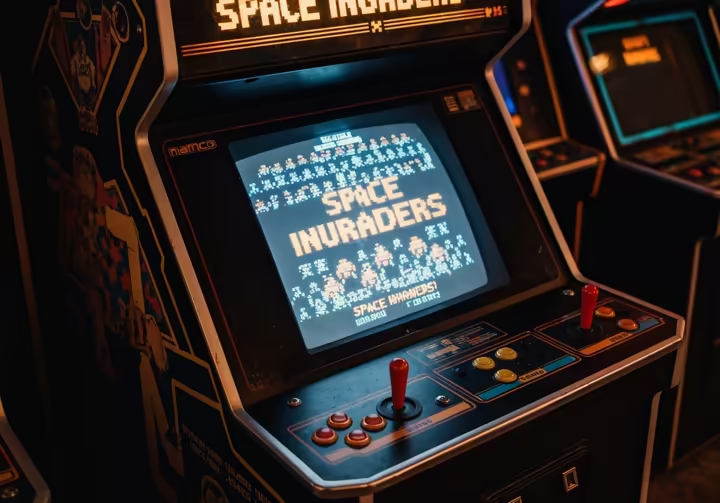
While sharing the Pac-Land board, its video system was similar to the one used in Dragon Buster , showing how Namco adapted its technology for different games. 1 The audio, from the music to the sound effects, was all done by composer Junko Ozawa. 1 Credits on the later NES port also revealed programmer Hiroki Aoyagi, who likely worked on the arcade original too. 17
Controls and Co-op
In the arcade, the controls were simple. You used an 8-way joystick with a trigger to fire your machine gun, and a separate large button for the loop-de-loop maneuver. 1
A big deal for its time, Sky Kid was Namco's first-ever game to feature simultaneous two-player cooperative gameplay. 1 This turned the usually lonely arcade shooter into a shared event. This formula worked, as the game was a commercial hit in Japan.
The publication Game Machine listed it as the second most-successful table arcade unit in its January 15, 1986 issue. 1
How to Fly (and Fight)
The goal in Sky Kid is straightforward. Player one flies the red biplane of the "Red Baron" and player two flies the blue "Blue Max", names that are nods to World War I pilots. 1 Each mission involves taking off, flying through enemy territory, grabbing a bomb, and dropping it on a target like a base or a battleship. 1
A unique quirk of the game is that the action scrolls from right to left. 21 You have a machine gun ('A' button) to shoot down enemies, but your most important move is the loop-de-loop ('B' button). 1 This move lets you dodge bullets and is the only way to reverse your plane's direction to get behind an enemy. 21
The catch is, once you pick up the mission's bomb, you can no longer perform the loop-de-loop. The 'B' button is now used to drop the bomb, forcing you to fly more defensively until the target is destroyed. 24
The two-player mode is delightfully chaotic since you can collide with your partner and friendly fire is always on. 24 Shooting your partner's plane causes them to stumble, but it can also be helpful. If an enemy hits your friend and sends them into a dive, you can shoot them to help them recover, a mechanic the NES manual called a demonstration of "the power of friendship". 25
Instead of dying in one hit, a damaged plane begins to fall. This gives you a frantic window to pull up on the joystick and regain control, turning failure into a dramatic fight for survival. 5
Sky Kid on the NES
Many players, especially in North America, first experienced Sky Kid on the Nintendo Entertainment System. Namco released the game on the Famicom in Japan in August 1986. Sunsoft published the North American NES version a year later in September 1987. 1

The NES port couldn't fully match the arcade's graphics, resulting in a simpler look with fewer colors. 27 Still, the artists kept the game's "chibi" charm. 6 Junko Ozawa's "Sky Kid March" was expertly rearranged for the NES's sound chip, becoming a classic chiptune. 1
The controls were adapted for the NES controller, with the D-pad for movement, 'A' for the machine gun, and 'B' for the loop-de-loop and bomb drop. 22 Some feel the NES version's planes move slower while the enemies are more aggressive, creating a different challenge. 27
New Additions and Changes
The NES version added exclusive content. It had "Target Practice" bonus rounds and "girlfriends" on the ground who would toss up hearts for bonus points if you performed a loop-de-loop for them. 5 Some minor arcade features were removed, like the pre-mission briefing screen. 5
One funny change involved the dancing girls near the landing strip. In the arcade, shooting them turned them into strange, pinkish blobs, for the family-friendly NES, they just turned into cats. 5 It's also worth noting that the start screen's "A" and "B" options are not difficulty settings. "A" is the 1-Player mode ("Baron"), and "B" is the 2-Player mode ("Baron & Max"). 18
Hidden Stuff
Sky Kid is filled with secrets that reward curious players. One of the best secrets involves the "power-up girls." Shooting specific background objects, like a dancing flower or a snowman, will make a woman appear and drop a helpful item. 28 These items could be a smart bomb that clears all enemies or a temporary shield for invincibility.

You can also find hidden playing cards by shooting specific parachuting soldiers. Collecting all the cards to spell S-K-Y-K-I-D gives you an extra life. 7 There are also fun interactions that don't affect gameplay.
Performing a loop-de-loop near the sun turns it into a moon, making the level dark. 7 A loop near the Statue of Liberty makes her skirt fly up. 28 Looping over certain billboards can also reveal classic Namco characters like Pac-Man or Pooka for extra points. 1
If you're struggling, the NES version has a hidden continue code. At the game over screen, hold Down and Left on the second controller while pressing Start on the first to continue from your last mission. 26 For score chasers, a direct hit on the very center of the main target yields a massive 10,000-point bonus. 21
Still Flying High
While not as big as Pac-Man or Galaga , Sky Kid is a beloved cult classic. It was a success in Japan, but many players in the West only knew it from the NES port. 1, 7 Reviews often mention its high difficulty and repetitive nature but always praise its charm, memorable music, and fun co-op play. 1
The game got a sequel, Sky Kid Deluxe , in arcades in 1986, which featured new missions and enemies on more powerful hardware. 1 An arcade version of the NES port was also released as VS. Super Sky Kid . 1 Today, the easiest way to play is through Namco's many retro compilations, which have appeared on consoles from the PlayStation to the Nintendo Switch. 1
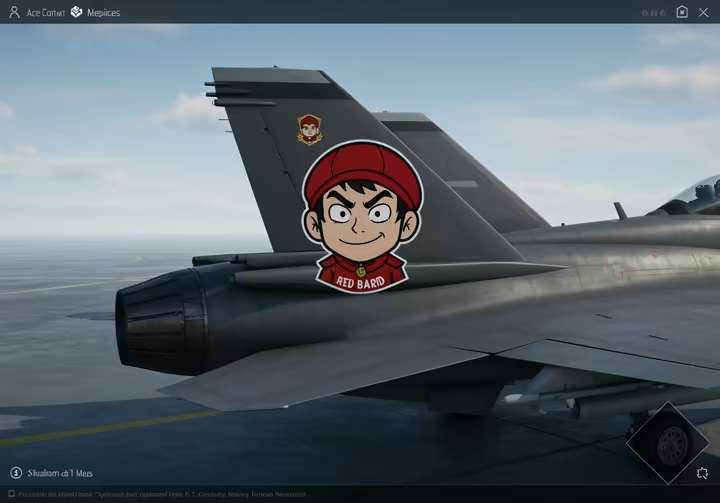
Perhaps the best sign of its legacy is in Namco's Ace Combat series, which is filled with references to Sky Kid . These include a bar named "Sky Kid" and a whole squadron named the "Sky Kid Squadron," with pilots called "Red Baron" and "Blue Max". 1 It’s a clear nod from one generation of Namco developers to another.
Final Thoughts
Sky Kid 's personality is what makes it a classic. It stood out by being cheerful, not by having the most advanced graphics. The combination of its "chibi" art style and Junko Ozawa's upbeat "Sky Kid March" turned aerial warfare into a playful cartoon. 5
The game balanced this lighthearted feel with challenging gameplay that was rewarding to master. 6 Its introduction of two-player co-op was a key innovation, turning the high-score chase into a shared adventure, complete with friendly-fire chaos. 1
The game has no real ending, after the final mission, it just loops with increased difficulty. 34 This seems fitting for a game that isn't about finishing a story, but about the simple joy of taking to its bright, welcoming skies.
Works cited
- Sky Kid - Wikipedia, https://en.wikipedia.org/wiki/Sky_Kid
- Sky Kid [Arcade Longplay] (1985) Sipem - YouTube, https://www.youtube.com/watch?v=Z64Bfnyswuw
- Chibi (style) - Wikipedia, https://en.wikipedia.org/wiki/Chibi_(style)
- Unveiling the Adorable: A Journey through the History of Chibi Art and Its Internet Reign, https://medium.com/@purplebubblestudio/unveiling-the-adorable-a-journey-through-the-history-of-chibi-art-and-its-internet-reign-58c7e362b484
- Sky Kid - Digital Press Online, http://www.digitpress.com/reviews/skykid.htm
- Sky Kid Review for Arcade Games: Bomb's Away! - GameFAQs, https://gamefaqs.gamespot.com/arcade/583990-sky-kid/reviews/175216
- The Great Gaymathon Review #52: Sky Kid (Famicom) - The Gay Gamer, http://www.thegaygamer.com/2012/02/great-gaymathon-review-52-sky-kid.html
- Sky Kid Original Soundtrack by Junko Ozawa streaming on YouTube Music - The Ongaku, https://www.theongaku.com/posts/sky-kid-original-soundtrack
- Sky Kid (Original Soundtrack) [Game Sound Effect] | NBGI-0023 ..., https://vgmdb.net/album/19428
- Namco - Wikipedia, https://en.wikipedia.org/wiki/Namco
- How Pac-Man Revolutionized Gaming | The MIT Press Reader, https://thereader.mitpress.mit.edu/how-pac-man-revolutionized-gaming/
- Sky Kid (1985) - MobyGames, https://www.mobygames.com/game/16483/sky-kid/
- Sky Kid Deluxe - Wikipedia, https://en.wikipedia.org/wiki/Sky_Kid_Deluxe
- Coinop.org /// Pac-Land (1984) (パックランド), https://www.coinop.org/Game/100125/Pac-Land
- Pac-Land - Wikipedia, https://en.wikipedia.org/wiki/Pac-Land
- Interview with Namco legend Junko Ozawa - Spillhistorie.no, https://spillhistorie.no/2020/10/30/interview-with-namco-legend-junko-ozawa/
- Sky Kid (NES) - The Cutting Room Floor, https://tcrf.net/Sky_Kid_(NES)
- Sky Kid (NES) Retro Review - 0% Imagination - WordPress.com, https://samearl13.wordpress.com/2016/06/22/sky-kid-nes-retro-review/
- Sky Kid - full playthrough with commentary - YouTube, https://m.youtube.com/watch?v=_YnCyxjvG7A
- Sky Kid (Arcade [Classics]) Co-Op Information - Co-Optimus, https://www.co-optimus.com/game/8391/classics-arcade/sky-kid.html
- Sky Kid, 1985 Namco (20 From 1985 #15) - YouTube, https://www.youtube.com/watch?v=yBfx-337-mQ
- Take on the NES Library » loop-de-loop, https://takeontheneslibrary.com/tag/loop-de-loop/
- Sky Kid Deluxe Arcade Game Review - MAMECADE 55 - YouTube, https://www.youtube.com/watch?v=l9ys8i7s4zE
- Sky Kid - Guide and Walkthrough - NES - By Revned - GameFAQs, https://gamefaqs.gamespot.com/nes/587625-sky-kid/faqs/34844
- Sky Kid - Nintendo NES - Manual - gamesdatabase.org - The Game Is Afoot Arcade, https://www.thegameisafootarcade.com/wp-content/uploads/2017/03/Sky-Kid-Game-Manual.pdf
- Sky Kid Cheats, Codes, and Secrets for NES - GameFAQs, https://gamefaqs.gamespot.com/nes/587625-sky-kid/cheats
- Sky Kid NES arcade authenticity - shmups.system11.org, https://shmups.system11.org/viewtopic.php?t=128
- VS. Super Sky Kid, 1986 Namco - YouTube, https://www.youtube.com/watch?v=Yvo5jk6B_f0
- Sky Kid Review (NES) | Nintendo Life, https://www.nintendolife.com/reviews/vc/sky_kid_nes
- Sky Kid Cheats - NES Cheats Guide - IGN, https://www.ign.com/wikis/nes-cheats/Sky_Kid_Cheats
- Namco Museum - Wikipedia, https://en.wikipedia.org/wiki/Namco_Museum
- Review: Namco Museum Archives Vol. 1 (2020) - MLGG, https://midlifegamergeek.com/2021/08/03/review-namco-museum-archives-vol-1-2020/
- Sky Kid Review for Super Cassette Vision: Overlooked, and still great fun today!, https://gamefaqs.gamespot.com/scv/951976-sky-kid/reviews/53598
- Sky Kid (2008) | NES Game - Nintendo Life, https://www.nintendolife.com/games/nes/sky_kid
- Sky Kid (FC · Famicom) video game port | 27-mission (1 loop ..., https://www.youtube.com/watch?v=VwKrmn-YzBg